Two Dresses. Two Problems Solved.
What to wear when presence matters and when it just needs to be Tuesday.
I don't write about specific pieces every week. When I do, it's because something has passed every filter I apply before I'd put it in front of you: does it belong in a real wardrobe, not a fantasy one; does it hold up across more than one context; does the woman wearing it look like herself, or like she's wearing a dress.
These two passed.
They're also solving different problems, which is why I wanted to write about them together. The way you dress for presence and the way you dress for a Tuesday are related questions, but they're not the same question. Most women get the occasion dressing mostly right and the everyday dressing mostly wrong. The result is a wardrobe that works for specific moments and fails the rest of the time — which is most of the time.
Both of these pieces came to my attention the way most things I recommend do: I encountered them while I was looking for something specific, and they stopped me. That doesn't happen often. When it does, it's worth paying attention to.
The Satin Dress That Does the Work for You
The Maeve Jamie Satin Halter Maxi Dress from Anthropologie is the kind of piece that makes the rest of your wardrobe feel more intentional by proximity. Satin at this silhouette — halter neck, maxi length, clean through the body — is doing something specific. It's communicating occasion without announcing it. You're not dressed for an event. You're dressed for a life that includes events, which is a different and more interesting signal.
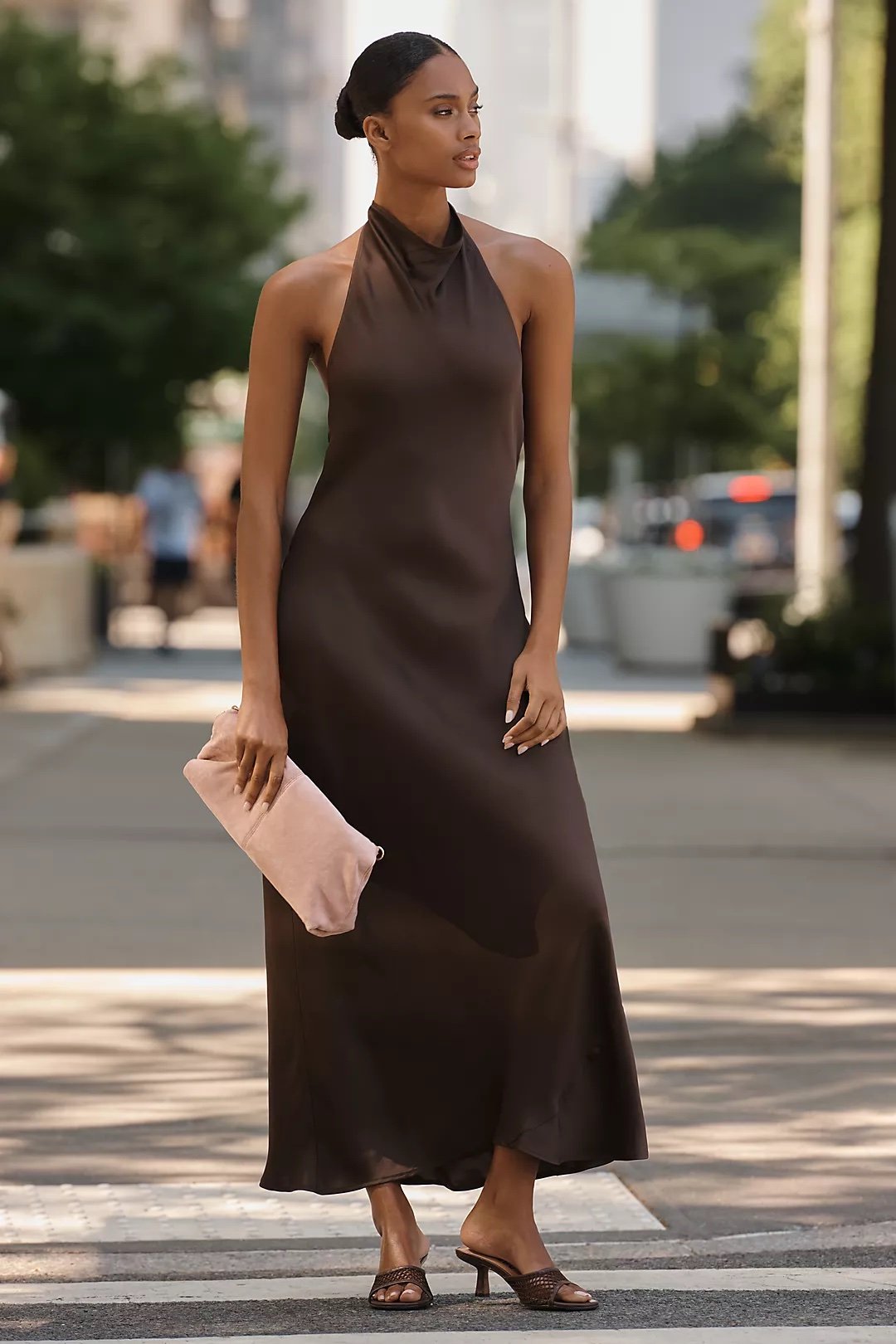
The distinction matters. A dress that screams occasion gives you away — it tells everyone in the room that you got dressed for this particular moment, which is fine but limiting. A dress that communicates general presence while being appropriate for a specific occasion tells a different story: that you always look like this. That this is simply how you show up. The Maeve Jamie does the second thing.
The halter neck is doing authority work that a standard strappy dress doesn't. There's a precision to it — a commitment to a specific line — that reads as intentional rather than casual. It's a structured choice. The neckline has architecture. And architecture, in clothing as in everything else, communicates that someone made a decision.
The maxi length keeps the whole thing from sliding into cocktail territory. This is not a going-out dress. It's a presence dress. The length takes it somewhere more interesting — the intersection of ease and authority, a difficult place to live in clothing, which this dress navigates well.
The satin itself deserves a note, because satin is a fabric that requires confidence to wear. It reflects light. It moves. It communicates that you are not trying to be invisible, which is true of all presence dressing but is more immediately visible in satin than in matte fabrics. If you have been dressing to disappear in professional contexts — a pattern I see constantly and which is one of the most expensive habits a woman can have — this is not the dress for you yet. If you have done or are doing the work of dressing for the level at which you actually operate, this is exactly the dress.
How to wear it: a flat sandal for ease, a clean heel for edge. Nothing around the neck — the halter does that work already. One earring if you have an opinion about jewelry. None if you don't. The dress is making enough decisions. You don't need to make more.
Where to wear it: a dinner where the conversation matters more than the venue. An event where you want to be remembered for being in the room rather than for what you were wearing. A summer occasion that requires presence without performance. A trip where you need one dress that can move from afternoon to evening without a wardrobe change.
What it communicates: I am here. I am considered. I did not overthink this.
Shop it: Maeve Jamie Satin Halter Maxi Dress, Anthropologie
The Midi That Belongs in a Real Wardrobe
The Lina Midi Dress from J.Crew is solving a different and in many ways harder problem — the one most women encounter more often than the satin dress problem.
The problem it's solving is this: you need to get dressed on a Tuesday. Not for anything specific. Just for the day, which will include a call, probably an errand, possibly a lunch, and a school pickup if you have children. The day that makes up most of your life but that most wardrobes are not actually built for.
Most wardrobes are built for two things: occasions and casual. The vast middle ground — the professional weekday that isn't formal but isn't casual, the life that requires you to be put together without being overdressed, the Tuesday that asks you to look like yourself without thinking too hard about it — is where most wardrobes fail. And they fail because getting this right is harder than it looks, and because the pieces that do it well are less exciting to buy than the pieces that solve occasion dressing.
The Lina Midi is built for that Tuesday. It solves the real problem with the quiet efficiency of a piece that knows exactly what it is.
The midi length keeps it professional without requiring heels. This is not a minor thing. The length that works for flats is one of the most useful qualities a dress can have — it means the dress functions across shoe choices, which means it functions across more of your actual life. A dress that requires heels to work is one that only works when you're in the mood for heels, which isn't every Tuesday.
The silhouette is easy without being shapeless. There's enough structure to read as deliberate — it's not a tent, it's not a sack — but it doesn't demand a specific body position or require you to sit carefully. You can wear this and forget about it, which is the highest compliment you can pay a weekday dress.
J.Crew's fabric quality at this price point is worth trusting. It moves the way clothes should move — without requiring your attention. Without bunching in the wrong places or pulling or shifting. It stays where you put it, which sounds like a low bar until you've spent a day in a dress that doesn't.
What I like specifically about this piece is that it doesn't ask you to style it. It works with what you already have. A flat sandal in summer. A low boot in fall. A clean sneaker on the days when you decide you're done pretending you want to wear anything else. It doesn't need a layer, though it takes one well. It doesn't need jewelry, though it won't compete with yours if you want to wear some.
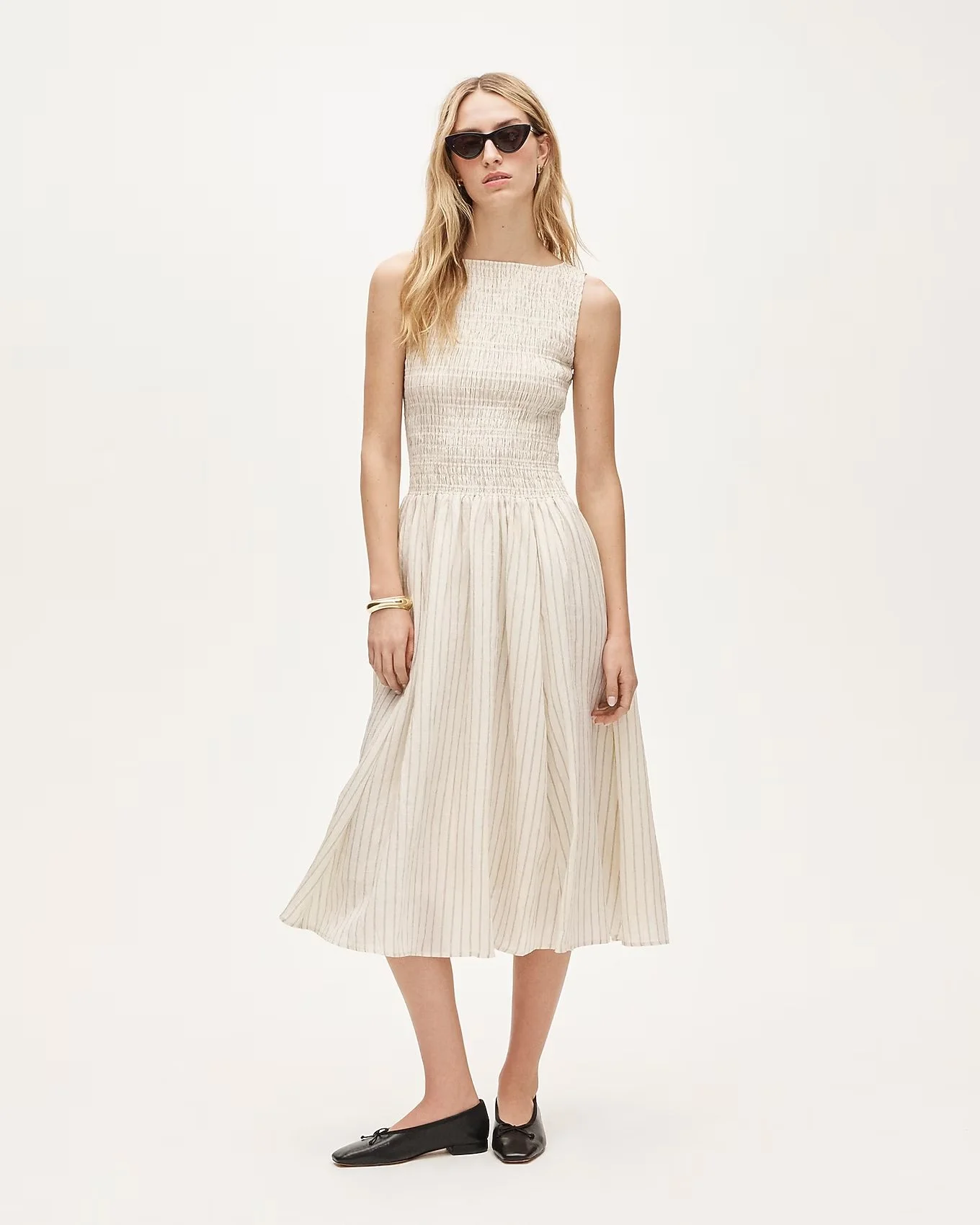
This is what a wardrobe anchor looks like at a reasonable price point. Not a statement piece. Not a conversation starter. The thing that makes your other things make sense. The piece that you reach for on a Tuesday morning because it's the right answer and you know it before you finish your first cup of coffee.
Most women don't have enough of these. They have plenty of interesting pieces and not enough reliable ones. The reliable ones are the foundation. The interesting pieces are what you add on top. If the foundation isn't there, the interesting pieces never quite work the way they should.
Where to wear it: the professional weekday, the school pickup, the errand that turns into an unexpected lunch, the Zoom call that might become an in-person meeting, the Saturday that needs to be presentable without trying. Every context that constitutes most of your actual life.
What it communicates: I know who I am. I got dressed in under five minutes. I look exactly like myself.
Shop it: Lina Midi Dress, J.Crew
The Edit
Two dresses. Different problems. Both worth owning.
The Anthropologie satin is for the version of your life that requires presence — the occasions, the dinners, the moments that call for you to show up in a way that registers. The J.Crew midi is for the version of your life that requires you to be dressed without thinking about being dressed — the Tuesday, the Wednesday, the ordinary professional day that makes up most of your time.
Most wardrobes need both. Most women buy neither, because they're waiting for the right occasion or the right budget moment or the right version of themselves, and in the meantime they get dressed in things that are fine but not quite right. Fine-but-not-quite-right is expensive over time. Not in the cost-per-wearing sense, though that math also doesn't favor it. In the energy sense. In the way it requires a small amount of additional effort every time you wear it, every time you look in the mirror and feel the low-grade friction of something that's almost right but isn't.
The whole project of dressing well — and by well I mean accurately, at your level, in a way that feels like you — is the project of reducing that friction. Of building a wardrobe where reaching for the right thing is easy because the right things are what you have. Both of these pieces move you closer to that.
Buy the one that solves your most immediate problem and come back for the other one when the time is right.
That's the edit.
This article includes affiliate links so I may earn a commission at no cost to you!