Style Presence
What your clothes communicate before you speak.
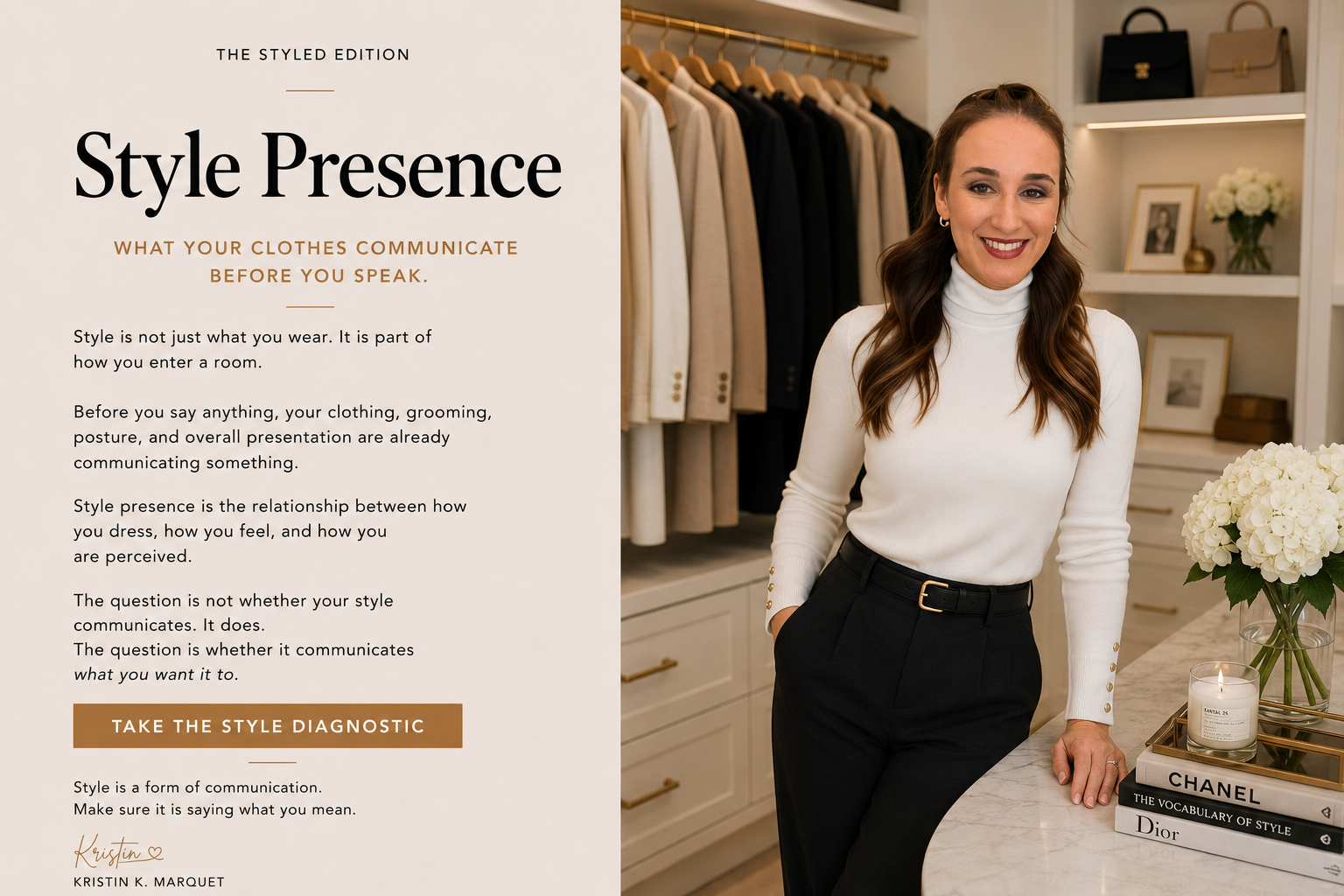
Style is not just what you wear
It is part of how you enter a room.
Before you say anything, your clothing, grooming, posture, and overall presentation are already communicating something. That does not mean you need to dress for other people. It means your style has presence, whether you shape it intentionally or not.
Style presence is the relationship between how you dress, how you feel, and how you are perceived.
It is the visual language you carry with you. It is the quiet signal your wardrobe sends before you speak, before you introduce yourself, before anyone knows the full story. This is not about perfection. It is about balance.
The goal is not to look like someone else. The goal is to look like yourself with more confidence.
Why style presence matters
The way you show up can influence how you feel in your own body, how prepared you feel for the day, and how clearly your external presentation reflects your internal identity.
When your style feels disconnected, you may feel slightly off before the day even begins. Not because anything is dramatically wrong, but because something is not quite aligned.
The outfit may be fine.
The pieces may be nice.
But the overall impression may not feel like you.
That disconnect can affect how you move, how you carry yourself, and how confident you feel in ordinary moments.
When your style feels aligned with who you are, you do not have to think about it as much. You can move through your day with more ease.
Style is a form of communication
Your clothes may communicate:
polish
ease
creativity
authority
warmth
confidence
practicality
refinement
The question is not whether your style communicates. It does. The better question is whether it communicates what you want it to.
This does not mean dressing for approval. It means recognizing that your visual presence is part of how you move through the world.
A simple outfit can communicate intention.
A polished jacket can create structure.
A well-chosen shoe can shift the tone.
A consistent color palette can make your style feel more recognizable.
When your presence feels inconsistent
Sometimes the issue is not that your wardrobe is wrong. It is that your style lacks a through-line.
You may have pieces you like, but they do not always work together. You may dress one way for work, another way for errands, another way for events, and another way when you want to feel comfortable. That is normal.
But when the gap becomes too wide, style can start to feel fragmented. Your wardrobe may include too many versions of you at once, without a clear connection between them.
Style presence helps bring those pieces into conversation.
It asks:
What impression do I want to create consistently?
What do I want my clothes to support?
Where does my wardrobe feel aligned and where does it feel unclear?
You do not need a dramatic reinvention to strengthen your style presence.
Start with three areas.
1. Fit
Fit changes everything. A simple outfit that fits well will usually read more polished than an expensive outfit that does not.
Fit affects proportion, comfort, movement, and confidence. When something pulls, gaps, drags, squeezes, or overwhelms you, it changes how you feel in it. Better fit creates ease.
Not because the outfit is complicated, but because you are no longer adjusting yourself around it.
2. Consistency
A recognizable style does not mean wearing the same thing every day. It means having a through-line. That through-line may come from:
color
shape
texture
proportion
simplicity
structure
softness
accessories
repeated outfit formulas
Consistency helps your style feel intentional. It gives your wardrobe a point of view.
When your pieces feel like they belong to the same woman, your style presence becomes stronger.
3. Finishing pieces
Shoes, bags, jewelry, belts, coats, and jackets often create the final impression. They are the details that make a simple outfit feel complete.
A basic outfit can become polished with the right shoe.
A neutral look can become distinctive with jewelry.
A casual combination can feel more refined with a structured bag or jacket.
Finishing pieces matter because they shape the tone of everything else. They are often the difference between dressed and styled.
The photo test
One of the simplest ways to understand your style presence is to look at recent photos of yourself.
Not to criticize, but to notice.
Ask:
Do I look like myself?
Does anything feel visually off?
What do I want more of?
What do I want less of?
This is an exercise in awareness.
Sometimes photos reveal what mirrors do not. You may notice that a color drains you, a proportion feels heavy, or a certain outfit makes you look more like yourself than anything else.
Those observations are useful. They help you refine.
What style presence is not
Style presence is not about being overdressed. It is not about luxury labels. It is not about dressing for strangers. It is not about becoming more visible in a way that feels uncomfortable.
Style presence is about creating visual consistency between who you are and how you show up.
Frequently Asked Questions
What is style presence?
Style presence is the way your wardrobe and overall presentation communicate before you speak. It connects clothing, identity, confidence, and impression.
How can I improve my style presence?
Start with fit, consistency, and finishing pieces. These three areas can make your wardrobe feel more intentional without requiring a complete reinvention.
Is style presence about dressing for other people?
No. Style presence is not about dressing for approval. It is about making your outside feel more consistent with who you are and how you want to move through the world.
Why does my style feel inconsistent?
Your style may feel inconsistent if your wardrobe includes too many disconnected pieces, outdated items, or different versions of your life without a clear through-line.
What makes an outfit look more intentional?
Fit, proportion, finishing pieces, and consistency make an outfit feel more intentional. Even simple outfits look stronger when the details work together.
Can style affect confidence?
Yes. When your clothes fit well and reflect who you are now, you may feel more comfortable, prepared, and grounded in how you show up.