Style signature
How to find your personal style without starting over.
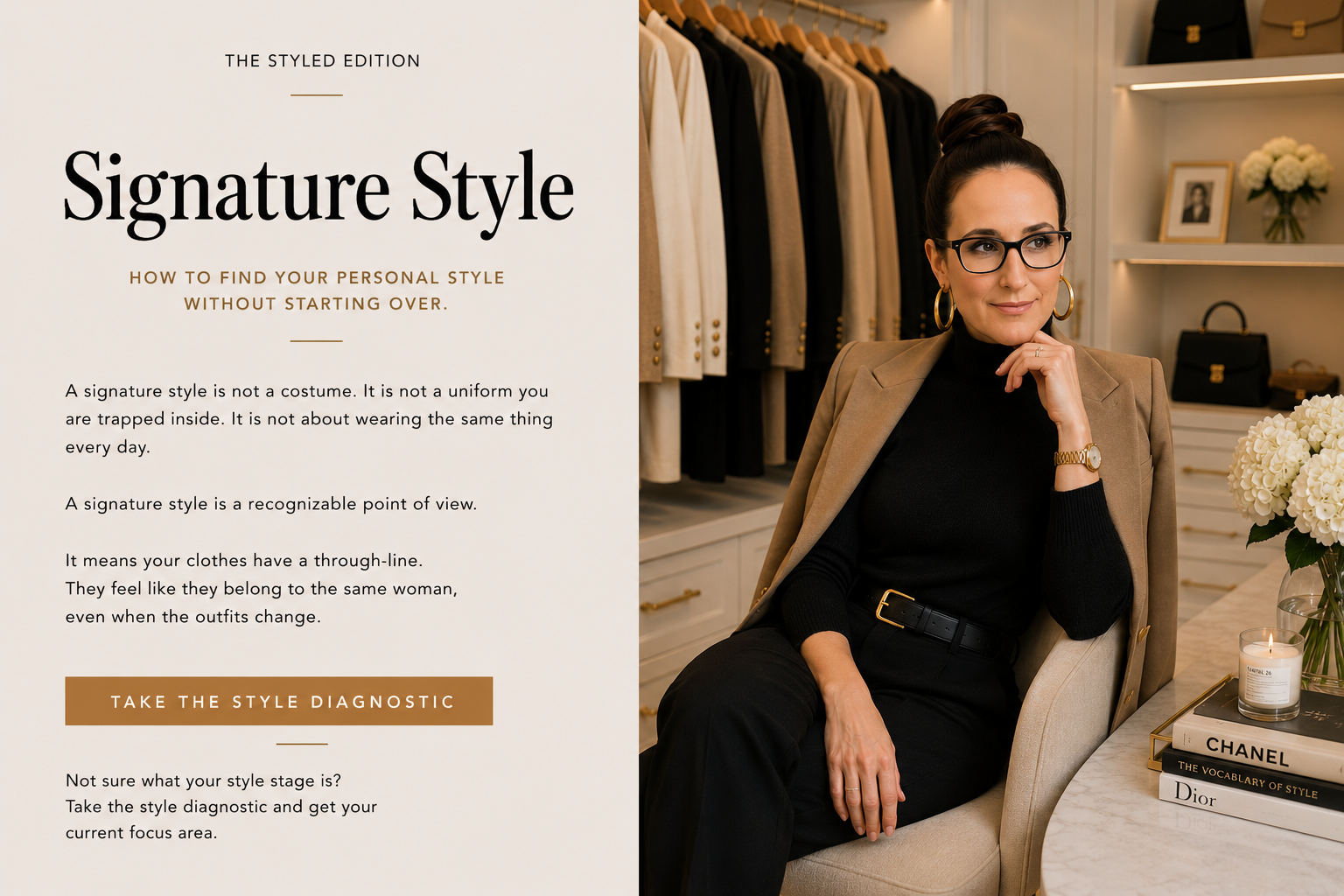
A signature style is not a costume, and it is not a rigid uniform you are expected to wear.
It is something far more nuanced than that—a consistency that makes your wardrobe feel cohesive, intentional, and unmistakably yours.
When a signature style begins to take shape, there is a subtle shift in how your clothes relate to one another. Outfits may change from day to day, but they still feel connected, as though they belong to the same woman, the same life, and the same point of view. There is less stress and chaos in getting dressed, not because you have fewer options, but because the options you do have make sense together.
This is not about starting over. It is about recognizing what is already working and refining it with more clarity.
Why signature style matters
Without a clear sense of style, even a well-filled wardrobe can feel uncertain. You may find yourself standing in front of your closet with plenty of choices, but very little direction. Shopping becomes a series of disconnected decisions, and pieces that seemed right in the moment fail to integrate into your daily life.
As your signature style becomes clearer, the process changes. You stop evaluating clothing in isolation and begin considering how it fits into a larger picture. Instead of asking whether you like something, you begin to ask a more useful question:
Does this belong in my world?
That distinction creates a different kind of discipline—one that is not restrictive, but clarifying. It allows you to edit more easily, shop more intentionally, and build a wardrobe that feels coherent rather than accumulated.
Your style is already present
Most signature styles are not invented; they are uncovered. If you look closely, patterns are already emerging in the way you dress. There are pieces you return to without hesitation, outfits that feel easier to wear, and combinations that consistently feel right. These repetitions are not limitations; they are signals.
You may notice that certain colors appear again and again, or that you gravitate toward particular silhouettes without fully realizing it. There may be fabrics that feel more natural on your body, shoes you reach for consistently, or pieces that seem to anchor multiple outfits. You may also recognize the opposite—items that remain unworn, combinations that feel slightly off, or purchases that never quite integrate into your life.
Together, these patterns begin to outline the structure of your style. They reveal both what belongs and what no longer does.
Choosing a direction
A signature style does not require a complete overhaul, nor does it demand that you eliminate variety. Instead, it asks you to choose a direction, a way of dressing that feels aligned with who you are now and how you want to move through your life.
This direction becomes easier to define when you can describe it in simple, intuitive terms. Not as a rigid label, but as a feeling that guides your decisions.
The role of style words
One of the most effective ways to clarify that direction is through a small set of descriptive words. These words are not meant to categorize your style, but to anchor it.
You might find yourself drawn to combinations such as refined, warm, and modern, or polished, relaxed, and feminine. For others, the language may feel closer to minimal, soft, and structured, or classic, easy, and elevated. The specific words matter less than their ability to capture the tone you want your wardrobe to express.
Over time, these words become a filter. When you encounter something new, you instinctively evaluate whether it supports the direction you have chosen. If it does not, the decision becomes easier—not because the piece is objectively wrong, but because it does not belong within the system you are building.
How repetition creates recognition
A signature style becomes visible not through novelty, but through repetition.
This does not mean wearing the same outfit every day. Rather, it means that certain elements begin to recur in a way that feels intentional. A consistent color palette may start to emerge, or a particular balance between structure and softness. You may find yourself returning to similar proportions, familiar silhouettes, or a specific level of polish that feels natural to you.
These repetitions create continuity. They allow your wardrobe to function as a whole, rather than as a series of separate decisions. Over time, this continuity becomes recognizable—not only to others, but to you. Getting dressed becomes less about experimentation and more about refinement.
Avoiding the pull of the unreal
One of the more subtle challenges in developing a signature style is the pull toward a version of life that does not fully exist. It is easy to be drawn to clothing that represents an ideal—an aesthetic that feels compelling, but does not align with your daily reality.
A signature style cannot be built on occasional moments. It has to support your actual life—your work, your routines, your environment, and your preferences. When it does, it becomes sustainable. When it does not, it creates friction and stress.
The goal is not to dress for a different version of yourself, but to create a wardrobe that feels natural within the life you are already living.
What signature style becomes
As your style becomes more defined, it also becomes refined.
You spend less time questioning your choices and more time moving through your day. Your wardrobe begins to feel more cohesive, and your outfits require less adjustment. You may notice that you are buying fewer pieces, but wearing them more often, and that your clothing feels more consistent from one day to the next.
This is not about perfection. It is about the sense that what you are wearing reflects who you are in a way that feels both natural and intentional.
Frequently Asked Questions
What is a signature style?
A signature style is a consistent visual point of view that allows your wardrobe to feel cohesive, intentional, and recognizable over time.
How do I find my signature style?
It begins by noticing what you already repeat: your colors, silhouettes, and preferred combinations, and then refining those patterns into a clearer direction.
Can my signature style change?
Yes. A signature style should evolve as your life, identity, and preferences shift. It is not fixed, but it should remain consistent.
Do I need to simplify my wardrobe to develop a signature style?
Not necessarily. The goal is not fewer pieces, but more alignment between the pieces you have.
What if I feel drawn to multiple styles?
Most people do. The focus is not on limiting your range, but on identifying the through-line that connects your choices.
How long does it take to develop a signature style?
It develops gradually, through consistent choices and small refinements rather than a single defining moment for most women. It took me about two years to define my signature style!