Personal Style After 40
Dressing like yourself again.
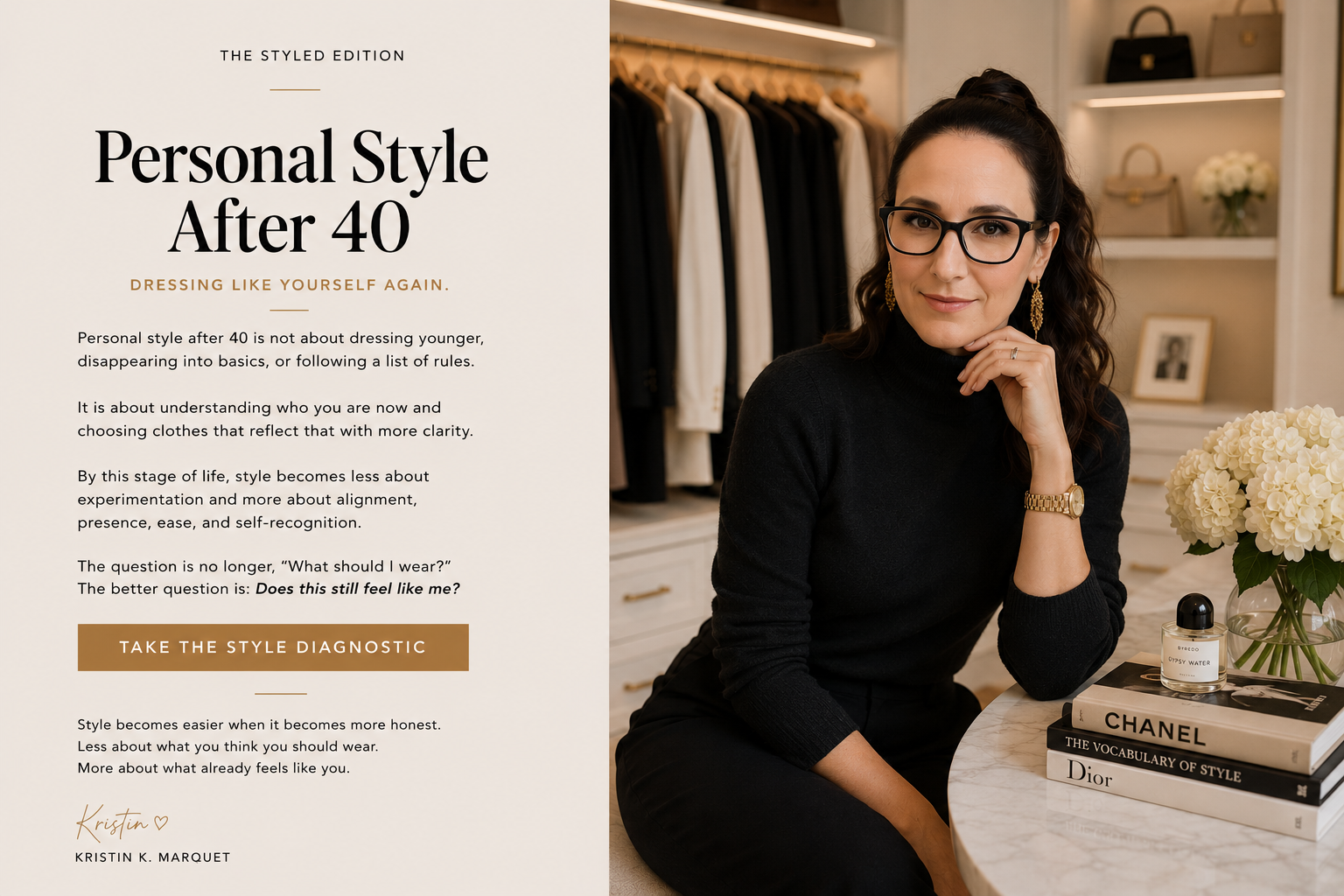
Personal style after 40 is not about dressing younger, disappearing into basics, or following a list of rules.
It is about understanding who you are now, and choosing clothes that reflect that.
There is a shift that happens over time. What once felt exciting may start to feel forced. What used to work may no longer carry the same weight. You may still like your clothes, but something about them no longer feels entirely honest.
That is where this change begins, not with a trend, not with a list, but with recognition.
The question is no longer, What should I wear?
The better question is:
Does this still feel like me?
Why style changes after 40
Style changes because life changes.
Your work may look different.
Your body may feel different.
Your priorities may have shifted.
Your social life may have changed.
Your sense of identity may be clearer, softer, stronger, or more nuanced than it used to be.
A wardrobe that once supported you can begin to feel slightly out of sync. Not wrong, exactly. Just no longer fully aligned.
This is often subtle at first.
You hesitate a little longer before getting dressed. Outfits feel acceptable, but not quite right. You buy something new, but it doesn’t integrate the way you expected.
It is not that your style has disappeared.
It is that it is asking to evolve.
When your wardrobe no longer reflects you
A wardrobe can remain visually intact while becoming emotionally outdated.
The pieces still fit. They may still be well-made.
But they no longer reflect how you live, how you think, or how you want to be seen.
You may be holding onto clothing that belongs to a different version of your life; a different pace, a different role, a different expectation.
When your life moves forward but your wardrobe stays where it was, getting dressed becomes more complicated than it needs to be.
Not because you lack options. But because you lack alignment.
Recognizing the shift
Most women notice this before they can fully articulate it.
You may find yourself saying:
“I have clothes, but nothing feels right.”
Or:
“I just don’t feel like myself in anything.”
Your outfits are fine. Your closet is full. And yet something is missing. You may avoid certain photos. You may second-guess simple choices.
You may keep buying pieces that never quite become part of your real life.
At the same time, you may feel a pull toward something more refined, more consistent, more like you, but clearer.
This is not confusion.
It is self-awareness.
Defining your style now
Personal style after 40 is not discovered all at once. It is clarified. It often begins by paying attention to what already works.
There are pieces you return to without thinking. Outfits that feel easier. Combinations that require less effort but feel more like you. That repetition is not a limitation. It is guidance to build a wardrobe that reflects you.
At the same time, there are pieces that no longer feel right. They may feel slightly dated, slightly uncomfortable, or slightly performative. Not obviously wrong, but not fully aligned either. Both of these observations matter.
They begin to shape a clearer understanding of what belongs, and what no longer does. From there, your style becomes easier to define. Not as a category, but as a feeling.
Refinement over reinvention
This stage of style is not about becoming someone new.
It is about removing what no longer reflects you so that what remains can stand more clearly. It is about choosing pieces that support your life as it is now, not as it used to be, and not as you imagine it might be.
You may find yourself wanting:
fewer pieces, but better ones
simpler outfits that still feel polished
consistency without rigidity
ease without losing intention
This is not a reduction. It is a refinement.
What to upgrade first
When your style begins to shift, the instinct is often to change everything. But the most effective changes are smaller. They happen in the pieces you wear most often.
A better pair of denim.
A more polished flat.
A structured bag that holds everything together.
A knit that feels intentional, not incidental.
A jacket or coat that finishes an outfit instead of interrupting it.
Jewelry you can wear without thinking.
These are not dramatic changes. But they change how everything else feels.
What personal style after 40 becomes
It becomes more subtle, but more defined.
You spend less time questioning your choices. Your wardrobe begins to feel cohesive. You repeat outfits without second-guessing them. You shop less, but more intentionally. You recognize yourself more easily in what you wear. Style stops being something you chase. It becomes something you return to.
Frequently Asked Questions
How do I find my personal style after 40?
Start by noticing what you actually wear, what no longer feels like you, and the direction you feel naturally pulled toward. Your style is often revealed through what you repeat.
How can I look polished after 40 without dressing older?
Looking polished is not about dressing older. It comes from fit, consistency, and choosing pieces that feel intentional rather than overly styled.
Do I need a capsule wardrobe?
Not necessarily. The goal is not to reduce your wardrobe to a number, but to create one that works where pieces feel connected and easy to wear.
Why does my wardrobe no longer feel like me?
Your wardrobe may reflect an earlier version of your life, identity, or routine. As those change, your style often needs to evolve as well.
What should I update first?
Start with the pieces you wear most often. Small upgrades in high-use areas tend to create the most noticeable shift.